

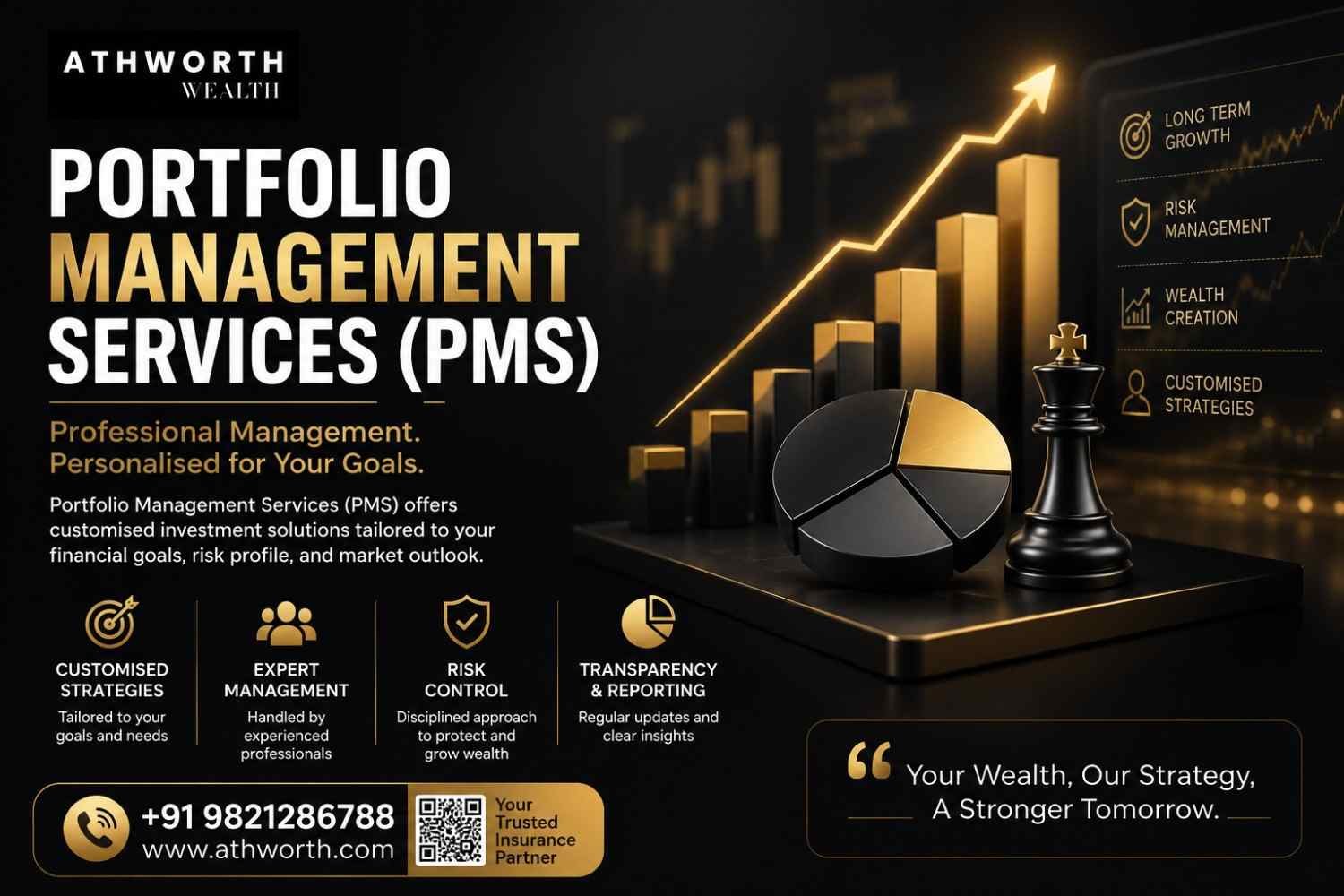
Portfolio Management Services (PMS) is a professional investment management solution designed for investors who want a personalized approach to managing their wealth. Unlike pooled investment products, PMS allows investors to own securities directly while a professional portfolio manager manages the portfolio according to an agreed investment strategy.
For high-net-worth individuals (HNIs) and sophisticated investors, PMS can provide greater customization, professional management, direct ownership, and flexibility. However, it also involves risks, fees, market volatility, taxation considerations, and a significant minimum investment requirement.
What Is Portfolio Management Services (PMS)?
Portfolio Management Services, commonly known as PMS, is a SEBI-regulated investment management service where an investor’s money is managed by a professional portfolio manager.
The portfolio manager studies the investor’s:
- Financial goals
- Investment horizon
- Risk tolerance
- Return expectations
- Investment preferences
Based on these factors, the manager creates and manages a personalized portfolio that may include equities, debt instruments, derivatives, and other securities.
One of the important differences between PMS and mutual funds is that the underlying securities in PMS are directly held in the investor’s Demit account. The content states that the SEBI entry requirement for PMS is ₹50 lakh.
The objective of PMS is not to provide fixed returns. Instead, active management aims to generate risk-adjusted returns or alpha while navigating different market conditions.
How Does PMS Work?
Understanding how Portfolio Management Services work is important before investing.
1. Client Onboarding
The process begins with onboarding the investor. The portfolio manager evaluates the client’s:
- Financial objectives
- Risk tolerance
- Investment horizon
- Preferences
- Overall investment requirements
This information helps the manager develop an appropriate investment strategy.
2. Portfolio Construction
After understanding the investor’s requirements, the portfolio manager creates a portfolio based on the selected strategy.
Depending on the investment approach, the portfolio may contain:
- Stocks
- Fixed-income instruments
- Derivatives
- Other eligible securities
The allocation depends on the investment strategy agreed upon with the client.
3. Ongoing Portfolio Management
The portfolio manager continuously monitors the investments and makes changes when necessary.
This can include:
- Buying and selling securities
- Portfolio rebalancing
- Responding to market opportunities
- Adjusting portfolio exposure
The objective is to manage the portfolio according to the selected investment strategy.
4. Regular Reporting
PMS investors receive reports covering portfolio performance, transactions, investment value, and strategy changes.
Regular reporting can help investors understand how their portfolio is performing and what changes have been made.
5. Performance Review
Portfolio performance is reviewed periodically with the client. Changes to the investment strategy may be considered when financial objectives or market conditions change.
Types of Portfolio Management Services
There are three primary types of PMS discussed in the content.
1. Discretionary PMS
In Discretionary Portfolio Management Services, the portfolio manager has the authority to make investment decisions on behalf of the client.
The manager can:
- Buy securities
- Sell securities
- Rebalance the portfolio
- Make investment decisions
The client does not need to approve every individual transaction.
This type of PMS may suit investors who prefer professional management with limited involvement in individual investment decisions.
2. Non-Discretionary PMS
Under Non-Discretionary PMS, the portfolio manager provides investment recommendations, but the client makes the final decision.
The manager can suggest securities and investment actions, but transactions are generally carried out after obtaining the client’s approval.
This approach provides professional guidance while allowing the investor to retain greater control over investment decisions.
3. Advisory PMS
In Advisory PMS, the portfolio manager primarily acts as an investment advisor.
The manager provides:
- Investment ideas
- Recommendations
- Market guidance
- Portfolio suggestions
However, the client executes the transactions. According to the source content, this model provides the least direct portfolio management among the three types.
What Is the Minimum Investment for PMS in India?
The content states that the minimum investment requirement for Portfolio Management Services in India is ₹50 lakh. This makes PMS primarily relevant to HNIs and investors who can allocate a substantial amount toward professionally managed investments.
Before committing this amount, investors should evaluate their:
- Financial goals
- Risk tolerance
- Liquidity requirements
- Investment horizon
- Existing portfolio
- Ability to withstand market volatility
The minimum investment alone should not be the reason to choose PMS.
Benefits of Portfolio Management Services
Personalized Investment Strategy
One of the biggest advantages of PMS is portfolio customization.
Unlike a standardized investment product, PMS can be structured around an investor’s financial objectives, risk appetite, and investment horizon. The content also highlights the ability to combine investment strategies according to the client’s requirements.
Professional Portfolio Management
PMS provides access to professional portfolio managers with knowledge of markets, industries, and securities.
Their experience can help with:
- Security selection
- Portfolio construction
- Market monitoring
- Rebalancing
- Investment decisions
However, professional management does not eliminate investment risk.
Direct Ownership of Securities
A major characteristic of PMS is direct ownership of securities.
The investor directly owns the securities in the portfolio, rather than owning units of a pooled fund. This can provide greater visibility into the individual investments held.
Greater Flexibility
PMS can offer greater flexibility in portfolio construction and management.
Portfolio managers can adjust investments, rebalance holdings, and respond to changing market conditions based on the selected strategy.
Potential for Higher Returns
A customized investment strategy and active management may provide the potential for better returns compared with some standardized investment options.
However, higher potential returns are not guaranteed, and only a small percentage of PMS providers may outperform the market consistently over long periods.
Disadvantages and Risks of PMS
PMS can be useful for suitable investors, but it is not appropriate for everyone.
High Minimum Investment
The ₹50 lakh minimum investment makes PMS inaccessible to many smaller investors.
Tax Considerations
Because PMS involves direct ownership of securities, gains are recognized in the investor’s hands. The content highlights an important difference compared with mutual funds: PMS investors can face taxation on realized gains from individual transactions rather than taxation being deferred until redemption of mutual-fund units.
Investors should understand the applicable tax rules and consult an appropriately qualified tax professional for their individual circumstances.
Higher Fees
PMS may involve management fees and, depending on the arrangement, performance-related fees.
Higher costs can reduce overall investment returns, particularly when portfolio performance is weak.
Performance Volatility
PMS portfolios can sometimes be concentrated and actively managed. As a result, performance can be more volatile than some diversified investment products.
Manager Dependency
The quality of portfolio management depends significantly on the manager’s investment philosophy, experience, research process, and decision-making ability.
Liquidity Risk
Some PMS portfolios may contain less-liquid securities. Investors should therefore consider how easily portfolio holdings can be sold and whether the investment fits their liquidity requirements.
PMS vs Mutual Funds
The key distinction is personalization and direct ownership.
| Feature | PMS | Mutual Funds |
|---|---|---|
| Portfolio | Customized | Pooled |
| Ownership | Direct securities | Mutual fund units |
| Management | Professional portfolio manager | Fund manager |
| Minimum investment | ₹50 lakh as stated in the source | Generally much lower |
| Customization | Higher | Limited |
| Investor control | Depends on PMS type | Limited |
| Tax treatment | Based on direct transactions | Primarily at redemption |
| Fees | Can be higher | Generally structured differently |
| Risk | Depends on portfolio strategy | Depends on fund |
The source specifically describes PMS as a customized portfolio held directly in the investor’s Demit account, unlike pooled mutual-fund investments.
Who Should Consider PMS?
PMS may be worth considering for investors who:
- Have substantial investable capital
- Understand market risks
- Want a customized portfolio
- Prefer direct ownership of securities
- Want professional portfolio management
- Have a long-term investment horizon
- Can tolerate market volatility
- Understand the fee and taxation implications
According to the source content, PMS is particularly relevant to high-net-worth investors who are comfortable with greater risk, higher fees and potentially lower liquidity in exchange for customized active management.
Important Factors to Consider Before Choosing PMS
Choosing the right PMS provider requires more than looking at historical returns.
Investment Philosophy
Understand how the portfolio manager selects investments and manages risk.
Ask:
- Is the strategy growth-oriented?
- Is the portfolio concentrated?
- What is the investment horizon?
- How does the manager handle market downturns?
Track Record
Past performance can provide useful information, but it should not be treated as a guarantee of future results.
Evaluate performance across different market cycles rather than focusing only on the latest returns.
Fees and Charges
Understand the complete fee structure before investing.
This may include:
- Management fees
- Performance fees
- Other applicable charges
The source recommends carefully considering fees because PMS costs can influence overall returns.
Portfolio Transparency
Review how frequently the PMS provider reports:
- Portfolio holdings
- Transactions
- Performance
- Strategy changes
Transparency is an important consideration when selecting a portfolio manager.
Liquidity
Check whether the portfolio contains securities that can be difficult to sell.
Your investment should match your liquidity needs.
Why PMS Can Be Considered for Large Portfolios
For investors with significant wealth, portfolio construction can become increasingly important.
For example, an investor with ₹1 crore spread across multiple mutual funds may discover that several funds hold many of the same large-cap companies. This can result in overlapping exposure.
A customized PMS portfolio may instead be structured around a specific investment objective and selected securities. The source uses this example to explain how PMS can potentially reduce redundant exposure through purposeful portfolio construction.
However, diversification, concentration and portfolio structure should always be evaluated according to the investor’s objectives and risk tolerance.
Is PMS Suitable for Every Investor?
No.
PMS requires a substantial minimum investment and can involve higher costs, direct taxation of realised transactions, greater volatility, liquidity considerations and dependence on the portfolio manager.
For investors with smaller amounts or simpler investment requirements, other investment products may be more suitable.
The right investment solution depends on your:
- Capital
- Financial goals
- Risk appetite
- Investment horizon
- Liquidity needs
- Tax situation
- Desired level of involvement
Final Thoughts
Portfolio Management Services (PMS) can provide a personalized approach to wealth management for investors who meet the minimum investment requirement and are comfortable with the associated risks.
Its major features include professional management, direct ownership of securities, portfolio customization and flexibility. At the same time, investors should carefully evaluate fees, taxation, volatility, liquidity, transparency and manager performance before making a decision.
The goal should not simply be to find the PMS provider with the highest historical return. Instead, investors should look for a strategy and portfolio manager that align with their financial goals, risk profile and investment horizon.
Important: PMS investments are market-linked and returns are not guaranteed. Investors should review the applicable regulatory documents, fee structure, risks and taxation implications and seek professional advice where appropriate.
Frequently Asked Questions About PMS
1. What is Portfolio Management Services (PMS)?
PMS is a SEBI-regulated investment management service in which a professional portfolio manager manages a customized portfolio according to the investor’s objectives and risk profile.
2. What is the minimum investment required for PMS?
The source states that the minimum investment required for PMS in India is ₹50 lakh.
3. What are the different types of PMS?
There are three primary types: Discretionary PMS, Non-Discretionary PMS and Advisory PMS.
4. How is PMS different from mutual funds?
PMS provides a customized portfolio with direct ownership of securities in the investor’s Demit account, while mutual funds pool investors’ money into a common fund.
5. Is PMS suitable for beginners?
PMS is generally designed for investors with substantial capital and an understanding of market risks. Investors should assess their financial situation and risk tolerance before considering it.
6. Does PMS guarantee higher returns?
No. PMS does not guarantee returns. Although active management may provide the potential for better performance, investment returns depend on market conditions and the portfolio strategy.
7. What are the main risks of PMS?
Important risks include market volatility, performance risk, manager dependency, liquidity risk, fees and taxation considerations.
8. Does PMS have higher fees than mutual funds?
PMS can have higher management and performance-related fees than mutual funds, although the exact fee structure varies by provider.
9. Can PMS portfolios be customized?
Yes. Personalization is one of the key features of PMS, allowing the investment strategy to be aligned with an investor’s objectives, risk appetite and investment horizon.
10. Should I invest in PMS?
There is no universal answer. PMS may suit HNIs seeking customized, actively managed portfolios, but investors should first evaluate their capital, risk tolerance, liquidity requirements, fees, taxation and investment objectives.